Black Gold (2012)

24 February 2012

synopsis
expand

Black Gold. Under the unforgiving desert sky, two warring leaders come face to face. The bodies of their warriors litter the battlefield. The victorious Nesib, Emir of Hobeika (ANTONIO BANDERAS), lays down his peace terms to his rival Amar, Sultan of Salmaah (MARK STRONG). The two men agree that neither may lay claim to the area of no man’s land between them called The Yellow Belt.

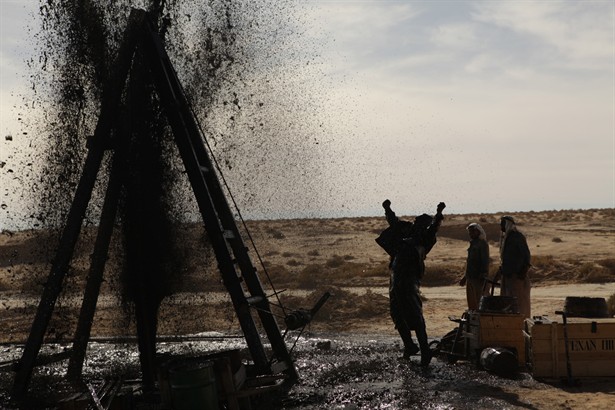
In return and according to the tribal customs of the time, Nesib will “adopt”- or take hostage- Amar’s two boys Saleeh (AKIN GAZI) and Auda (TAHAR RAHIM); a guarantee that neither man can invade the other. Years later, Saleeh and Auda have grown into young men. Saleeh, the warrior, itches to escape his gilded cage and return to his father’s land. Auda cares only for books and the pursuit of knowledge. One day, their adopted father Nesib is visited by an American oil man from Texas (COREY JOHNSON). He tells the Emir that his land is blessed with oil and promises him riches beyond his imagination.

Nesib imagines a realm of infinite possibility, a kingdom with roads, schools and hospitals all paid for by the black gold beneath the barren sand. There is only one problem. The precious oil is located in the Yellow Belt.

Saleeh is killed in his attempts to escape and return to his father’s kingdom. The task of negotiating peace between the two kingdoms falls to young Auda. Nesib orchestrates the wedding of his beautiful daughter, Princess Leyla (FREIDA PINTO) to Auda. Though that union is borne of political convenience, ridding Nesib of his final obligations to his peace treaty with Amar, for Auda and Leyla their marriage is the symbol of a new beginning, a love that began in their childhood and the chance to shape the world around them. Auda is sent to Salmaah as an emissary of peace. Reunited with his father Amar, he discovers a new outlook on life, one based on devotion, piety and humility. His father offers him a seemingly impossible task, to cross the forbidding desert landscape of the House of Allah, along with his half-brother Ali (RIZ AHMED), as a decoy with nothing more than a ragtag army of thieves.

The idea is to trick Nesib and allow Amar to mobilise his real army and conquer the kingdom of Hobeika. Through his journey, which is filled with many spectacular battles against rival tribes and clansmen and sees him free the beautiful slave girl Aicha (LIYA KEBEDE), Auda is transformed from a librarian into a leader.

The stage is now set for an epic showdown for control of the Yellow Belt, for control of the two kingdoms, for control of the future.

advertisement
expand
photographs
expand
fan ratings
expand

  No-one has rated this movie yet - be the first! You must be logged in to rate a movie.

our review
expand

“There are a host of annoyances and inconsistencies which prevent Black Gold from being the historical epic it sets out to be...”

Esteemed veteran director Jean-Jacques Annaud has displayed a talent over the course of his career for taking factual occurrences and adapting them cinematically to great success. Yet his latest offering Black Gold, depicting the dawn of the oil boom in the Arab states of the early 20th century, feels less like a depiction of such a historical period, and more like a satirical parody of the set of events that were set to change the world to how we now know it to be.

The story takes place in 1930's Arabia amidst the rise of the oil industry, focusing on how such a profitable discovery affected two rival Sultans Amar (Mark Strong) and Nesib (Antonio Banderas), the former a devout Muslim and traditionalist, the latter more progressive, with an eye on the profits that oil could provide.

The pair are brought together for the first time in years due to the oil boom, having formerly made a pact whereby they remain out of each other's way.  As part of the calm agreement, Amar's two sons were left as hostages with Nesib, and it is the youngest Auda (Tahar Rahim) who is caught at the centre of the oil storm, as his allegiances are torn between his conservative father and the more liberal Nesib, both offering somewhat justifiable causes.

The decision from Nesib to allow Americans to use the land to export the oil causes a rift between neighbouring towns, and war breaks out. Auda must then decide whose side he must fight on, as he not only battles for freedom and peace, but for the love of his beautiful wife Princess Leyla (Freida Pinto), the daughter of Nesib.

Despite telling a quite important and contemporary tale which holds mush resonance with its audience, there are a host of annoyances and inconsistencies which prevent Black Gold from being the historical epic it sets out to be. One of the greater misgivings comes in the casting, as despite presenting a host of talented actors, it is difficult to look past the fact that none of them are actually Arabic. It was almost as if the casting director thought, "they're ethnic - they'll do". I mean, surely I don't need to be the one to point out that Banderas can't be Pinto's dad? She's Indian, and he's, well, not. The film is rife with insignificant but frustratingly niggling aspects, as Annaud seems determined to steer away from the factuality of the time in which this film is set.

When attempting to ignore such contradictions in the plot, there are still a host of frustrations that prevent Black Gold from truly working as a feature film, most of which are apparent in the terrible dialogue. I'm almost certain I heard Nesib call someone a "Son of a bitch". And how about the "Oh for God's sake" line? It's set in the desert in the 1930's for crying out loud., people didn't speak like that then. The worst however comes when Leyla makes a cheeky innuendo about losing her virginity on her wedding night when speaking to her Arab father and Sultan. I mean come on.

On a positive note, the performances are acceptable, and the lead Rahim is very impressive. It's not the first time we've seen him rise from nothing to being revered and feared as he does in A Prophet, but he plays it so well because he can be equally as vulnerable and naive as he can be fearless and unflinching. Banderas is also good, and alongside Riz Ahmed playing Auda's long-lost brother, adds a touch of light-heartedness to proceedings, although I'm unsure whether this is the actual intention. I was expecting Banderas to wink to the camera at one point.

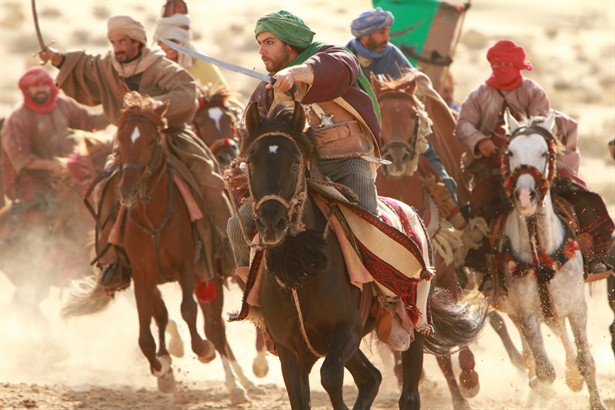
The film also looks fantastic, filmed in the vast wilderness of Tunisia, it is colourful and vivacious, and the battle sequences look so daunting taking place against such surroundings, enhanced by the blurred vision caused by the dusty sand emanating from the hordes of fighting men and camels, adding a real authentic and quite intimidating atmosphere as it becomes quite difficult to make out what is going on.

Yet such positives are cut short, as the film is mostly unimpressive. It's full of clichés, it's immoderate and exaggerated, and all too 'Hollywood'. It's okay when a feature revels in its own fatuousness, but the film attempts to be serious and political and when counteracted by jovial inanity it just doesn't work. Really it should be much more historically accurate given the subject matter, but instead goes down the cinematic route. We've all seen lead protagonists worm their way out of the most unlikely of situations, somehow avoiding death when their sworn nemesis holds a gun to their head. But Annaud just takes it a step too far as Auda is literally shot in the head and he survives, feeling perfectly well in a matter of minutes. Shot... In the head!

Black Gold is not the film it wishes to be, as Annaud's picture is overstated and too long at a little over two hours, nevermind the fact it's entirely boring. One to avoid, I'd say.

poster
expand
poster
buy poster
film information
expand
  • Release Date
  • 24 February 2012
  • Cast
  • Tahar Rahim, Mark Strong, Antonio Banderas, Freida Pinto
  • Director
  • Jean-Jacques Annaud
  • Writer
  • Menno Meyjes (screenplay), Jean-Jacques Annaud, Alain Godard (adaptation) & Hans Ruesch (novel "Arab")
  • Company
  • Warner Bros.
  • Genre
  • Drama
  • Runtime
  • 130 minutes
video media
expand