
RED + BLUE + LASER LIGHT TREATMENTS: Explore How Light-Based Technology Is Being Used For Chronic Wound Healing

It has been seen that nearly 2.5% of the total population of the United States lacks quality of life because of chronic wounds.
Chronic wounds are a big public health issue that the medical field is constantly trying to tackle. They’ve come up with a variety of treatments and medications to help heal wounds as fast as possible.
Light therapy has gained a lot of attention lately for its potential to help wounds heal faster. Even NASA has chimed in, saying that using red light therapy can work 50% faster healing time for lacerations. [Source: NASA Research Illuminates Medical Uses of Light]

[Source: Human Wound and Its Burden: Updated 2022 Compendium of Estimates - PubMed]
- If you are interested, how about learning more about the evolution of light-based treatments?
Introduction to Light-Based Technology in Wound Healing
[Source: Don’t be SAD: A Very Brief History of Light Therapy]
Taken from history, light therapy offers non-invasive, practical solutions for a wide range of health conditions. But what is light therapy? The answer is here:
[Source: Phototherapy (Light Therapy): Uses, Benefits & Risks]
How Light Therapy Works in Healing?
Photobiomodulation (PBM), its other name, is low-light therapy, which is behind the function of light-based treatments in wound healing. This whole function relies on the interaction of specific wavelengths of light with cellular components. What it does is trigger the biological cascade of events to do the tissue repairing and regeneration.
When the cells start to absorb light, cell metabolism is stimulated, better blood flow occurs, and inflammation is reduced. This absorption speeds up the healing process, collagen production, and scar disappears.
Types of Light-Based Technologies Used in Wound Healing
Red Light Therapy
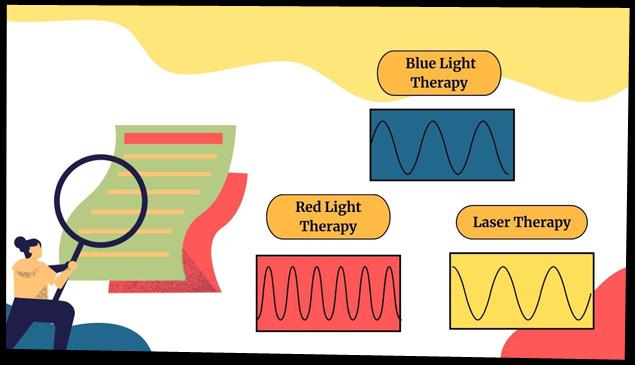
Red light therapy is one of the most popular forms of light-based technology. It uses a power of 630 and 700 nanometers wavelength of red light to stimulate cellular activity.
Now, coming to the part on how red light therapy aids in healing:
- Red light therapy is known for collagen production; it is their primary responsibility to produce protein for tissue repair and skin elasticity. This therapy even maintains blood circulation and takes nutrients and oxygen to injured tissue.
- Red light therapy removes any kind of inflammation and discomfort to make the healing process suitable.
Common Applications of Red Light Therapy, you ask:
- Improve blood flow and tissue regeneration to treat diabetic ulcers
- Reduce or fade the burn scar or any kind of scars
- Expedite tissue repair for post-surgery recovery.
Blue Light Therapy
Here's another one with blue light, using light-based tech. This therapy is also the same as red light; the difference is that it uses a wavelength of 450 nm to 479 nm to kill bacteria. You will find blue light therapy to be used when needed to combat the infection that causes obstacles to the healing process.
How blue light works in wound healing, one may wonder. This is how:
- Blue light goes deeper into the cell walls of bacteria. Start disrupting their DNA and prevent the bacteria from multiplying.
- The light lowers the risk of infection by reducing bacterial load. After this, you will see how fast the wound heals.
Specific Conditions Treated with Blue Light Therapy:
- Killing acne-causing bacteria and healing the acne lesions.
- Prevent infection and speed up the healing process of minor wounds.
Laser Therapy
Can’t forget about the laser therapy. They are another successful therapy in light-based technology. It was created to deliver precise doses of light energy to damaged tissues. The laser radiation will be in between 800 to 1100 nm wavelength range. Another thing is laser therapy has two types of wound healing.
- Low-Level Laser Therapy (LLLT) stimulates cellular activity with low powers. It works to reduce inflammation and make the healing process faster.
- High-intensity lasers are for deeper tissue penetration. They are primarily seen in healing chronic wounds and surgical wounds.
What are the effectiveness and safety of laser therapy?
- Reduce the healing time
- Improve the quality of newly formed tissues
- Better functional outcomes
The Science Behind Light-Based Healing
Does light-based healing sound unfamiliar? How about light therapy? Now you know what we are talking about. These therapeutic approaches are now widely popular for treating various skin problems. This therapy uses light with a specific wavelength to give light energy to the skin and alleviate multiple medical conditions.
But scientifically speaking, how does this therapy actually work? Let’s look at the image below to understand the step-by-step functioning of light therapy.

[Source: https://pearlriveracupuncture.com/light-therapy/]
Practical Applications of Light-Based Technology in Healthcare
Common Medical Use Cases
- Speed up the healing of pressure sores and ulcers
- Reduces inflammation and pain
- Lowers the risk of infection
- Improve the quality of life for long-term care patient
Post-Surgical Recovery Aid
- Minimizes post-operative pain
- Faded the scarring
- Expedite wound healing
- The risk of getting an infection is reduced
Use in At-Home and Clinical Settings
- Portable light therapy devices for self-treatment
- Easy to use and convenient
- Suitable for minor wounds and chronic conditions
- Come in any size according to your preference
Clinical Setting
- Advanced equipment for complex wound
- Controlled environment for optimal treatment
- Professional supervision for personalized care
Emerging Research and Future of Light-Based Wound Healing Technology
Recent Studies on Light Therapy in Wound Healing
- Enhanced wound healing: We have found a clinic report on light therapy, which speeds up wound healing in diabetic rats by about 38% just by using a 633nm laser at 10 J/cm². They mention how using low-level laser therapy (LLLT) to treat diabetic wounds can be safe and effective. [Source: Additive enhancement of wound healing in diabetic mice by low-level light | Scientific Reports]
- You will find many studies on the internet about how light theory reduces the pain connected with wounds and gives the patient comfort.
Innovative Technologies on the Horizon
- The development of wearable LED devices has opened a gate for more customized wavelengths and intensities of light to use in treating individual patients. It now directly heals the wound site and continues healing without disruption.
- AI algorithms are another wonder that collects patients' data to determine the severity of the wound and the healing rate. It then plans the light therapy treatment according to this information. With the help of AI-integrated light-based treatments, you can even be informed beforehand by knowing the compilation early on.

How to Choose Light-Based Therapy for Wound Care
Frequently Asked Questions
What types of wounds benefit most from light-based therapy?
The light-based therapy healing process works best and fast on chronic wounds like diabetic ulcers, pressure sores, and venous ulcers, even on surgical wounds and dermal burns.
Is light therapy for wound healing safe for everyone?
Generally speaking, yes. But there is no harm in talking to a dermatologist before going under light therapy to get advice for your skin conditions.
How quickly can one see results from light therapy?
The healing time will most likely depend on the wound's severity and individual response. However, it may take 2 to 4 weeks to see the results if we take about time.
Are there side effects to using red or blue light therapy?
There are, but those side effects are very mild and moderate. You may face temporary skin redness or irritation. Serious side effects are rare.
Can light therapy replace traditional wound care methods?
Light therapy is seen as a complementary treatment alongside traditional methods. It can speed up the process but doesn't replace standard wound care practices.
No Comment