

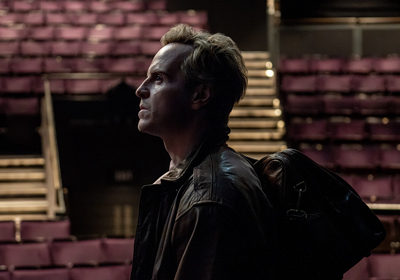
"Andrew Scott is the only leading man I can imagine bringing such emotional depth and raw passion to this role"
Presented as the Opening Gala feature at this year’s London Film Festival, Elsinore celebrates Ian Charleson’s life and legacy, both in the performing arts and within the LGBTQ+ community.
Directed by Simon Stone and written by Stephen Beresford, Elsinore focuses on a snapshot of Charleson’s life: his final theatre performance as Hamlet at the National Theatre, before losing his long battle with HIV.
Both Stone and Beresford have built bodies of work centred on theatre, and their styles couldn’t be more perfect for Elsinore. Filming a play within a movie is never easy, but Stone finds the perfect balance between celebrating theatre as an art form and showcasing the passion, dedication and hard work required to bring a production to the stage. And what a stage it is, with the Hamlet production in the film set at London’s National Theatre.
The film begins with Ian Charleson still living in the shadow of Chariots of Fire, with the echoes of the film’s success following him wherever he goes. Yet he wants more from his career: to leave a greater mark and not simply be remembered for playing an athlete.
Alongside his professional struggles, Ian is also living a lie. His decision not to be openly gay has pigeonholed him into straight male roles that fail to fulfil his potential as an artist. Adding to the weight on his shoulders is the constant reminder that, as someone living with HIV, his health could deteriorate at any moment, and his chances of making his big break might be numbered.
As fate would have it, when Daniel Day-Lewis walks out during the opening night of Hamlet, director and friend Richard Eyre offers Ian the chance to return to the stage and take on Shakespeare’s most acclaimed play.
Ian accepts the role against his doctor’s advice. His illness is progressing, and taking on such a demanding part could accelerate his deterioration. Surrounded by death, both in life and in art, Charleson goes on to give the performance of his life: a legacy that lives on, celebrated and remembered for years to come.
With such a tragic story, emotions run high throughout the film. Andrew Scott is the only leading man I can imagine bringing such emotional depth and raw passion to this role.
His performance is never over the top. Instead, the combination of Shakespeare’s work, which remains as relevant today as ever, and Scott’s extraordinary talent makes for a winning hand.
And with such a powerful leading man at the centre of the story, the rest of the cast can do nothing but follow his lead. His scenes with Olivia Colman are a masterclass in partnership and impeccable line delivery. The rest of the ensemble dances around them, creating an atmosphere of camaraderie that makes the audience believe in the relationships unfolding on screen.
Both Ian’s closest friends and his castmates support him, knowingly and subconsciously, until the very end. This creates a fascinating dichotomy with the story unfolding in Hamlet. While Shakespeare’s prince fights almost alone amid lies and deceit, Ian walks his own path, trying to stop living a lie and find the courage to be honest with himself and the world.
With a powerful lead performance, an ensemble of exceptional British talent, and a director and writer who deeply respect, understand and love theatre as an art form, Elsinore has all the right ingredients for a delicate and heartfelt story. It celebrates the life and legacy of an actor who, through both his life and his work, gave back to a community that has long struggled to be recognised and to have its experiences matter, especially during some of its darkest times.
No Comment