
Put The Heart Of Your Film Before The Budget: A Conversation with Faith Elizabeth and Daphne Schmon
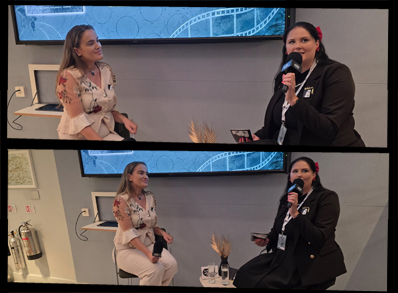
At the London Rolling Film Festival, Faith Elizabeth and Daphne Schmon discussed financing, investors, difficult film sets, stars, rejection and why filmmakers shouldn’t be afraid to tell people why their story matters.
“Why are you making this film?”
It sounds like one of the easiest questions a filmmaker could possibly answer.
Yet somewhere between development, budgets, casting, financing, festival submissions and distribution, it can become surprisingly easy to forget.
At the London Rolling Film Festival’s Women Driving Change in Film & Television industry panel, held in collaboration with Yes She Cannes, Faith Elizabeth and Daphne Schmon spent much of their discussion looking at the practical realities of independent filmmaking.
Money certainly mattered.
So did casting.
So did investors.
So did recoupment.
But the conversation continually returned to something underneath all of them.
People.
The people making the film.
The people financing it.
The people filmmakers meet along the way.
And the human reason somebody decided the story needed to exist in the first place.
YOU WRITE ONE FILM, SHOOT ANOTHER AND EDIT ANOTHER
Filmmaking rarely goes precisely according to plan.
“You write one film, you shoot another, you edit another,” Schmon observed while discussing the compromises inevitably made during production.
Plans change.
Shots disappear.
Money runs out.
Circumstances change what can practically be achieved.
But Schmon argued that compromise shouldn’t mean abandoning respect and communication.
She spoke candidly about having felt pushed aside during a production as things she regarded as part of its “heart and soul” disappeared.
Importantly, she didn’t present that purely as a director-versus-producer problem.
The opposite happens too.
Producers can devote enormous amounts of time and effort to getting a film made and then find themselves barely acknowledged once attention turns towards the finished work.
Elizabeth stopped the conversation and asked the producers in the room to identify themselves.
Then she asked everybody to applaud them.
“Producing is hard.”
For independent filmmakers, it can be particularly hard because producing is frequently another job somebody has assumed out of necessity while simultaneously writing, directing or performing another creative role.
But producers also possess an enormous opportunity.
They can set the culture of the production.
THE BEST CV DOESN’T NECESSARILY MEAN THE BEST COLLABORATOR
Film productions naturally chase experience.
Someone has substantial credits.
They’ve worked on recognisable productions.
Perhaps their involvement looks impressive on IMDb.
Elizabeth argued that another consideration can be just as important.
How will that person affect everybody around them?
Someone with fewer credits who believes in the film, respects their collaborators and cares about the story may ultimately be considerably more valuable than somebody with an extraordinary CV who behaves as though they’re doing the production a favour.
Elizabeth had an unusually concentrated example.
During a four or five-day shoot for ASKING4IT, which screens at LRFF, the production removed two people on separate days.
They were paid.
But keeping somebody simply because confronting the situation would be difficult wasn’t considered the better option.
What happened afterwards vindicated the decision.
The cast and crew became closer.
Trust increased.
People stepped forward.
The production became more efficient.
And the atmosphere improved.
Sometimes leadership requires having the conversation nobody particularly wants to have.
But Elizabeth also stressed that improving a working environment doesn’t always require authority.
Notice somebody struggling?
Talk to them.
Something doesn’t feel right?
Quietly approach the producer.
Someone feels invisible?
Make them feel seen.
Small interventions can produce disproportionately large changes.
FIND YOUR PEOPLE
That philosophy extended beyond production.
Schmon argued that smaller independent film festivals can sometimes provide more valuable relationship-building opportunities than the enormous events everybody dreams about attending.
Cannes and Sundance obviously have immense industry importance.
They can also be enormous, fast and overwhelming.
A smaller festival creates something different.
You encounter the same filmmakers repeatedly.
You actually watch one another’s work.
Conversations started in the morning continue that evening.
People have time to become people rather than names on badges.
Schmon praised the atmosphere at LRFF and the connections being formed there, while Elizabeth described the festival as “small but mighty.”
Elizabeth illustrated the point with an experience at an unnamed BAFTA-qualifying festival.
Expectations were high.
Reality wasn’t.
After travelling to attend, they discovered virtually no audience and only around ten filmmakers.
By conventional measures, it could have been dismissed as a disaster.
Instead, those ten filmmakers bonded over the experience.
They laughed.
They formed friendships.
They supported one another afterwards.
Some eventually worked together.
One subsequently became BAFTA-longlisted.
The festival they thought they were attending wasn’t particularly valuable.
The relationships they created there were.
ONE STEP CLOSER TO YES
Independent filmmaking involves rejection.
Lots of it.
And Elizabeth acknowledged an instinct familiar to almost anybody trying to get something made:
Someone says no.
Perhaps that means the project isn’t good enough.
Schmon challenged that conclusion.
During her first documentary, she reached a point where she was editing herself, learning as she worked, living with her parents and barely sleeping.
“I can’t do this,” became the story she was telling herself.
A story editor challenged her to stop.
The problem wasn’t pretending that the mountain wasn’t enormous.
It was deciding what could actually be done next.
Elizabeth connected that idea with the staircase incorporated into the Cannes Film Festival imagery leading towards the Palme d’Or.
You don’t climb the whole staircase simultaneously.
You take one step.
Then another.
A rejection doesn’t necessarily tell you the project is bad.
Sometimes it’s simply another no before eventually reaching a yes.
DO YOU ACTUALLY NEED A STAR?
Then came the question that has haunted independent film financing forever.
Do you need a recognisable actor to get the money?
A name can help.
Nobody on the panel pretended otherwise.
But Schmon’s immediate advice was interesting.
Rather than automatically finding a star:
Find a way to bring the budget down.
An established actor or executive producer can lend credibility, attract attention and potentially make investors more comfortable.
But everything depends upon the economics of the particular production.
Elizabeth offered a useful hypothetical.
If a £100,000 film could secure a valuable recognisable performer for another £10,000, that might be an obvious opportunity.
But what if securing the star turns that £100,000 film into a £2.1 million production?
Now the actor needs to help generate enough additional revenue to justify another £2 million that has to be recovered.
The question therefore isn’t simply:
Can we get a star?
It’s:
Does this particular film need one?
“The budget needs to fit the story,” Elizabeth said.
Some films genuinely need scale.
Others don’t.
And spending more money doesn’t automatically make the latter better.
THINK ABOUT FILM NUMBER TWO
There’s a certain prestige attached to saying you’ve made an expensive film.
Schmon suggested filmmakers worry less about that number and considerably more about the number they ultimately recover.
Independent-film recoupment is extraordinarily difficult.
That makes every unnecessary cost significant.
Could the production move closer to home and eliminate hotels?
Could another financing arrangement work?
Could some participants take backend participation?
Could the story be made effectively for less?
There isn’t a universal answer.
But Schmon encouraged filmmakers to remember that the objective isn’t merely getting this film made.
There’s hopefully another one afterwards.
And convincing investors to support film number two becomes much harder when film number one came nowhere close to recovering its investment.
“Don’t think about the prestige,” she said.
Demonstrating that you raised the money, made the film and recovered the investment can speak considerably louder.
WHAT IF THE FILM DOESN’T RECOUP?
Own it.
Elizabeth argued that filmmakers shouldn’t walk into their next investor meeting attempting to conceal everything that went wrong previously.
Instead:
What failed?
Why?
What was within your control?
What wasn’t?
What would you change?
She argued that being able to say we got this wrong and this is what we’ve learned can actually create trust.
Trying to disguise failure because ego has taken over can do the opposite.
The filmmakers who make mistakes aren’t necessarily the problem.
Filmmakers who refuse to learn from them might be.
WHY DOES AN INVESTOR INVEST IN FILM?
Perhaps the most useful question of the morning turned the traditional financing conversation completely around.
Filmmakers spend enormous amounts of time thinking:
How do I persuade this investor to fund my film?
Elizabeth suggested asking:
Why does this person invest in films at all?
If somebody simply wants the safest possible financial return, there are other asset classes available.
Film can attract investors for completely different reasons.
Perhaps the subject affects them personally.
Perhaps they care about the social issue.
Perhaps they believe the story can change people’s minds.
Perhaps they want to help something culturally valuable exist.
And, yes, they may still want their money back.
Understanding what motivates the investor allows the filmmaker to discover whether there is genuine alignment between them.
Elizabeth compared the relationship to dating.
If one person is desperately chasing while the other holds all the power, it doesn’t create a particularly healthy balance.
Filmmakers don’t merely have to convince investors.
They can decide whether an investor is right for their film too.
STOP PITCHING YOUR CV
Then comes the pitch itself.
Filmmakers have been conditioned to establish credibility.
We’ve played these festivals.
We’ve won these awards.
We’ve attached this actor.
Our budget is this.
We’ve achieved that.
Elizabeth suggested starting somewhere else.
The heart.
What’s the story really about?
Why does it matter?
And why are you the person telling it?
She pointed towards several filmmakers whose work carried a deeply personal connection between storyteller and story.
Those connections aren’t limited to documentaries or social-impact films either.
Even a seemingly lightweight romantic comedy probably comes from somewhere.
Bad dates.
Loneliness.
Confidence.
Relationships.
Something caused its writer to sit down and tell that story rather than another one.
“Go straight to the mission and the message and the heart and the human,” Elizabeth told the room.
Awards and credentials still matter.
They’re just not necessarily the reason somebody will care.
PUT YOUR HEART ON THE TABLE
Schmon had seen the difference first-hand.
The writer of one of her features had lost her first boyfriend in a sudden drowning accident.
Initially, she didn’t want to discuss that experience while pitching.
She wanted the conversation kept on the film itself.
But that experience was part of why the film existed.
Once she began explaining the personal connection honestly, people reacted differently.
Schmon recalled another filmmaker telling stories about female immigrants who initially resisted discussing her own experience as an immigrant.
Again, the filmmaker wasn’t trying to make herself the subject.
She was explaining why she cared.
“There’s nothing as compelling as someone putting their heart on the table,” Schmon said.
That doesn’t mean filmmakers are obliged to turn their private lives into marketing material.
It means that authenticity can communicate something a budget sheet never will.
WHAT’S YOUR WHY?
The panel ended without a magic formula for making an independent film.
There isn’t one.
A star might help one project and financially cripple another.
A multimillion-pound budget might be essential for one story and absurd for the next.
A prestigious festival might transform a filmmaker’s career.
Or ten filmmakers sitting in an almost empty screening room might form relationships that prove more valuable years later.
What Faith Elizabeth and Daphne Schmon kept returning to was something more fundamental.
Know what you’re trying to make.
Know why you’re making it.
Find collaborators who care.
Build relationships instead of merely collecting contacts.
Treat investors as potential partners rather than cash machines.
Don’t confuse somebody’s credits with their character.
Don’t confuse budget with quality.
Don’t confuse rejection with failure.
And don’t be afraid to explain why this particular story matters to you.
Because long after the spreadsheets, pitches, applications and festival laurels have been stripped away, there’s still one question every filmmaker has to answer.
Why this story?
And perhaps the best place to begin is simply telling the truth.
No Comment