
Helen Oakleigh On Class, AI And Who Actually Gets The Chance To Make Films
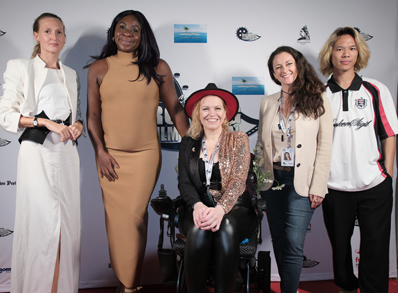
At the London Rolling Film Festival 2026, Helen Oakleigh turned the conversation towards class — asking not only how working-class people are represented on screen, but whether the structure of the film industry gives them a realistic opportunity to enter it, remain in it and tell the stories they want to tell.
Who gets to make films?
It sounds like a straightforward question.
Talent matters. Creativity matters. Experience matters.
But so does money.
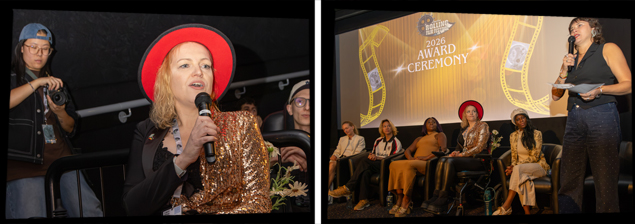
During the closing industry programme at the London Rolling Film Festival 2026, Helen Oakleigh examined working-class representation as part of a wider session exploring disability, class and queer representation across the screen industries.
The conversation began with what audiences see.
It quickly became a much bigger discussion about who gets the opportunity to create it.
WHO DO WE SEE ON SCREEN?
Oakleigh presented figures suggesting that working-class characters have historically accounted for approximately 15–25% of depicted roles in British and American narrative cinema.
Depending on the research and definition used, she said working-class people represent somewhere between approximately 40–56% of society.
At the opposite end of the scale, aristocratic, elite, high-society and ultra-wealthy characters were presented as accounting for roughly 30–40% of narrative cinema roles, despite the comparable real-world population being dramatically smaller.
The imbalance raises a familiar representation question.
Whose lives does cinema consider worth watching?
Oakleigh highlighted films including Kes, I, Daniel Blake, Educating Rita, Trainspotting and Rocks before inviting those attending to consider characters with whom they personally identified in relation to their own experience of class.
The resulting conversation immediately demonstrated why identity rarely fits neatly into one category.
Participants discussed The Hours, Breakfast at Tiffany’s and The Elephant Man, drawing connections between class, isolation, disability, identity and the way people perceive themselves.
It returned the session to Oakleigh’s wider argument about intersectionality.
People don’t live inside one box.
Neither should characters.
MONEY CHANGES WHO GETS TO TELL STORIES
Representation, however, cannot be separated from opportunity.
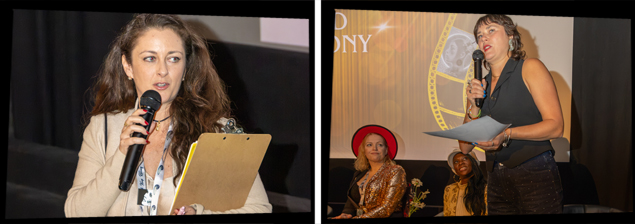
“If people who have more money want to make films, it is much more easy than people who have less money,” Oakleigh told the room.
It is an obvious point.
It is also one with enormous consequences.
Equipment costs money.
Training costs money.
Film school costs money.
Travelling to opportunities costs money.
And perhaps most importantly, spending years accepting poorly paid, sporadic or entry-level work while building a career is considerably easier if somebody has the financial security to survive between jobs.
Oakleigh therefore moved the discussion from representation within films to the economic circumstances determining who gets to make those films at all.
THEN THERE’S AI
Artificial intelligence made the issue considerably more complicated.
Oakleigh deliberately refused to present AI as simply good or bad.
“On the one hand, it’s very, very, very, very bad. On the other hand, it has opportunities that we’ve never seen before.”
For filmmakers without large budgets, increasingly accessible technology could provide tools that were once completely beyond their financial reach.
That could lower barriers.
A creator who couldn’t previously afford particular equipment, visual effects or production resources may increasingly be able to realise ideas that once required significantly greater financing.
For working-class filmmakers in particular, that possibility matters.
But so do the risks.
WHO BUILT THE TOOL — AND WHAT WAS IT BUILT FROM?
Oakleigh raised concerns around copyright, the use of creative work in training systems, environmental impact and the possibility of existing stereotypes being reproduced through new technology.
If systems are trained using historical material containing outdated stereotypes and problematic language, she argued, filmmakers need to remain conscious of what those systems may reproduce.
That makes the human element particularly important.
Technology may assist creativity.
It shouldn’t be allowed to define whose stories are told or what those people are supposed to look like.
Oakleigh also emphasised the importance of responsible use and regulation, referring to a recent speech by writer Jack Thorne concerning AI, copyright and protection for creatives.
Her recommendation to the room was telling: seek out what he actually said rather than relying purely upon headlines interpreting it.
WHAT HAPPENS TO THE PEOPLE WHO HAVEN’T BEEN HIRED YET?
For a discussion specifically about class, however, Oakleigh identified another potential consequence of automation.
Entry-level jobs.
Those jobs don’t merely provide income.
They provide training.
Experience.
Contacts.
The opportunity to watch experienced people work.
And a route into an industry that can otherwise be extremely difficult to enter.
Oakleigh put the problem starkly:
“The easiest people to replace on set are the people you haven’t employed yet.”
And the people who haven’t been employed yet may be precisely those who cannot afford alternative routes into the industry.
“The people who can’t afford to go to film school are most likely to be working class,” Oakleigh argued.
If technological efficiencies remove junior positions while professional training remains expensive, an apparently democratising technology could simultaneously remove one of the traditional routes through which people without money learned their craft.
PASSING THE SKILLS DOWN
That makes skills transfer important.
Oakleigh argued that people already established in the industry have a responsibility to create opportunities and help train those coming behind them.
The issue has become particularly significant following the disruption of recent years.
People have left the industry.
New people have arrived.
And the informal chains through which knowledge was traditionally passed from experienced crew members to junior colleagues can be broken surprisingly quickly.
Technology will continue to change.
But if the industry stops training people because software can perform some of the jobs they once learned through, eventually something more than an individual position disappears.
Knowledge does too.
Oakleigh described maintaining that transfer of skills as a “moral duty.”
WHAT DOES “WORKING CLASS” EVEN MEAN IN 2026?
The discussion then challenged the terminology itself.
Does Britain’s familiar division between upper, middle and working class adequately describe people’s lives in 2026?
Oakleigh introduced the seven-class framework associated with Professor Mike Savage, Professor Fiona Devine and the Great British Class Survey, which considers three forms of capital rather than relying purely on income or occupation:
Economic capital. Cultural capital. Social capital.
That distinction becomes particularly interesting when applied to creative industries.
An actor may have an impressive CV, know large numbers of people within the industry and regularly attend cultural events while earning very little money.
A musician can be highly trained while possessing little financial security.
A filmmaker can appear successful publicly while moving from contract to contract with no guarantee of what happens after the current production.
As Oakleigh pointed out, the public perception of an “actor” may be someone enjoying Hollywood fame and enormous earnings.
Most people with exactly the same job title experience something completely different.
“How on earth can you compare like for like?” she asked.
THE INDUSTRY SHOULDN’T DECIDE WHAT A WORKING-CLASS STORY LOOKS LIKE
Representation creates another paradox.
The industry can demand more authentic working-class voices while simultaneously holding preconceived ideas about what stories those filmmakers should tell.
During the discussion, one filmmaker spoke about the frustration of being expected to tell working-class stories in a particular way.
That raises an important distinction.
Inviting somebody into the industry because of their background isn’t genuine creative inclusion if they are then expected to reproduce somebody else’s definition of that background.
A working-class filmmaker may want to make social realism.
They may also want to make science fiction.
A psychological thriller.
A romantic comedy.
Or something that has absolutely nothing to do with class.
Authenticity means allowing creators to define themselves rather than simply giving them a different box to occupy.
WHEN YOUR ACCENT BECOMES A BARRIER
Class can also be heard.
Oakleigh spoke candidly about her own experience of accent discrimination and how differently she speaks today compared with the first 25 years of her life.
She described having had a thick, fast estuary accent and subsequently working extensively on diction and slowing her speech.
For an actor, learning to change an accent isn’t inherently problematic.
Being able to adopt different voices is part of the craft.
But Oakleigh drew a clear distinction between learning an accent to play a character and feeling compelled to change your natural voice because of the assumptions other people attach to it.
“You shouldn’t do that because people won’t take you seriously because of the connotations of your accent.”
Accent can therefore operate as another gatekeeper.
Before somebody has demonstrated their ability, another person may already have made assumptions about their intelligence, education, professionalism or background simply from the way they speak.
WHAT IF FILM JOBS COULD ACTUALLY BE PART-TIME?
Oakleigh then proposed a deceptively simple question.
Could more jobs in film be part-time?
The traditional production model can demand long hours followed by periods without employment.
For someone with savings or financial support, that uncertainty may be survivable.
For somebody living from one payment to the next, it may eventually make remaining in the industry impossible.
And the problem extends beyond class.
Parents have caring responsibilities.
Some people need second jobs.
Others have disabilities or circumstances that make conventional production schedules difficult.
People may enter the industry later in life precisely because earlier responsibilities prevented them from doing so.
Oakleigh argued that more flexible and part-time working structures could help retain people who would otherwise be forced to leave.
“If you’re having to do a gig economy where you’re going from one production, then you’ve got a gap. Then another gig. Then you’ve got a gap. You’ve got no stability. You can’t pay your bills, and you’re going to have to quit the industry inevitably.”
The industry spends considerable time discussing how to attract diverse talent.
Keeping that talent once it arrives is just as important.
QUIET ON SET AND THE CLASS DIVIDE
The discussion also highlighted work already examining these barriers, including Quiet Onset: The Class Division in the Film Industry, which Oakleigh drew attention to during the session as part of the wider conversation around class inequality and voices being excluded or silenced.
The point wasn’t that one film, one panel or one festival can solve the problem.
The structures involved are considerably larger than that.
But discussing them creates an opportunity to identify what can actually be changed.
FROM DISCUSSION TO CONNECTION
And Oakleigh wanted something practical to come from the room.
Rather than allowing the conversation to end when everybody left the venue, she suggested creating ways for participants to remain connected, share roles and opportunities and bring their own networks into the conversation.
“Be the change we want to see.”
It is a simple proposition.
If established routes aren’t providing opportunities, people can create new ones for one another.
If knowledge risks disappearing, pass it on.
If somebody is being excluded, ask why.
If working structures are forcing talented people out of the industry, consider whether those structures actually need to remain that way.
And as artificial intelligence changes what filmmaking looks like, don’t measure progress solely by how many jobs technology can perform more cheaply.
Ask who is being given the opportunity to learn the jobs of tomorrow.
Because democratising filmmaking means very little if the next generation still can’t afford to get through the door.
No Comment