


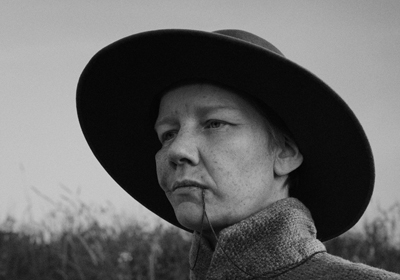
"Shot in black and white, the absence of colour tightens the emotional focus and reinforces the story’s rawness"
Rose is a historical drama written and directed by Markus Schleinzer, and it premiered in competition at this year’s Berlinale. At its centre is a woman living in 17th-century Germany who, to gain freedom and autonomy, disguises herself as a man. The film is inspired by true stories that survived in court records and sparse historical traces, and it confronts a society that feared deviations from prescribed roles.
Shot in black and white, the absence of colour tightens the emotional focus and reinforces the story’s rawness. As Schleinzer noted, black and white rearranges our gaze, keeping it firmly on the characters rather than on visual distraction.
Sandra Hüller gives a powerful performance as Rose, inhabiting her with a stillness that never feels passive. She carries with her the weight of experience, having lived under disguise to secure a place in a world that otherwise would not let her belong. A vocal part of her presence is in how she moves through life: disciplined, cautious, determined. Hüller’s physical restraint adds layers to the character’s interiority. Her performance was rightly recognised with the Silver Bear for Best Leading Performance at the Berlinale.
The story follows Rose’s attempt to simply live, work, and claim what she believes is rightfully hers. There is no tidy emotional arc and no happy ending, and that is part of the film’s force. Instead, the narrative leaves us with questions about freedom, identity, and the cost imposed by rigid social norms. In this world, stepping outside expectations carries real danger.
In the film, clothing and the act of dressing are never superficial. They are part of Rose’s constant negotiation with society, marking the tension between body, identity, and survival. Trousers are a practical, everyday garment that becomes a symbol of freedom.
The film addresses violence without needing to show it. As the director explained during the press conference, there is a responsibility to tell these stories, but no need to reproduce cruelty through images the internet is already full of. That restraint feels right here. The violence exists in the margins: in silence, in glances, in the way Rose must strategise her life minute by minute.
In the village where Rose seeks acceptance, nearly everyone else performs their assigned social role. Custom and fear shape the community. Rose and Suzanna, by contrast, step outside those roles.
Rose does not offer easy conclusions. It leaves the viewer with unresolved questions: why has so little changed, and why does conformity still come at such a cost? One of my favourite films in competition, not only for its historical grounding, but for the way it honours the story of an inspirational and deeply resilient woman.
No Comment