
Jennifer E. Montgomery on Memory, Resilience and Making This Tempting Madness
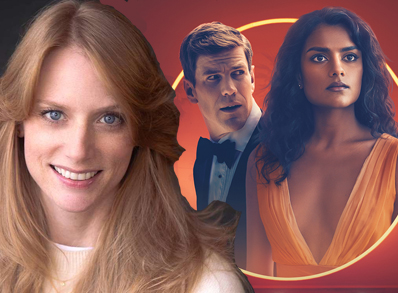
Jennifer E. Montgomery certainly didn’t choose the easy route for her feature directorial debut.
Inspired by the real-life experience of one of Montgomery’s closest friends, This Tempting Madness stars Simone Ashley as Mia, a woman left with brain damage and severe memory loss following a near-fatal fall. As Mia begins the long process of recovery, she attempts to piece together the events that led to her accident.
For Montgomery, who also co-wrote and produced the psychological thriller, bringing the story to the screen meant balancing the responsibility of telling something intensely personal with the creative freedom required to make a compelling narrative feature.
We caught up with Jennifer E. Montgomery to discuss the origins of This Tempting Madness, Simone Ashley’s understanding of Mia, recreating her friend’s recovery and what she learned from stepping behind the camera for her first feature….

If we go right back to the beginning, was there a defining moment when you knew you wanted to get into the film industry?
I remember being in school as a little kid and they would ask you, as a matter of course, “What do you want to be when you grow up?”
I wanted to be a ballerina—I studied ballet intensely—but I knew there were so many things I wanted to do. I also wanted to be a fireman, a policeman, a stockbroker; there were so many things I wanted to explore.
I remember sitting in my classroom thinking, “What is something I can do where I can explore everything and anything?” And I thought, “Oh, I can make movies.”
It was a strange way to arrive at wanting to be a movie director, but it happened young. I loved movies and continued to fall in love with them and gobble them up as a kid. That was my defining moment, and it just never changed, for better or worse. So here we are.
What can you tell us about This Tempting Madness and why you wanted to tell this particular story?
This film is inspired by a true story that happened to a very, very close friend of mine. It’s honestly one of those stories that comes to you; it’s not a story I sought out.
Unfortunately, something very tragic happened to her. At the beginning of the film, the character has a very violent fall, falls into a coma and, as a result, suffers brain damage. The rest of the movie is about her recovering her memory and trying to put together the pieces of what happened.
That’s something I very much went through with my friend. It took her a long time to regain even short-term memory for more than a minute at a time. Eventually she was able to retain short-term memories and had to be told what had happened, but it didn’t really make sense to her because it was something so confusing, mind-altering and earth-shattering.
Going through that process with her, I encouraged her to keep a journal as part of the healing process. She’s the kind of person who doesn’t like doing things just for herself; she’ll do things for other people more readily.
She said, “I don’t really need to keep a journal.”
I told her, “No, you really should. It’s going to help you.”
Her response was, “Why? Do you think you’re going to make a movie about it?”
I said, “Sure, yeah, that’s why.”
I had absolutely no intention of making a movie, especially about something so close to me. I was already living through it.
She kept the journal going for a year. When she was fully recovered, she came to me one day and said, “So, are you going to write something?”
I was completely blown away. I didn’t expect her ever to come around to that. I asked, “Do you want me to write something?”
She said, “I think it could be good. I think you should.”
My husband and I write together, so we talked about it for a long time to determine whether it was something we wanted to do. I had many more conversations with my friend to make sure it was something she wanted because it’s a very personal story.
Ultimately, I decided it was a story we should tell. There was a reason all the pieces were coming together. We wrote the script, it had a really great response, and here we are.
You’ve got two fantastic actors leading the film in Simone Ashley and Austin Stowell. Given how personal this story is to you and your friend, what was it like entrusting these characters to them?
The script had a really positive response, so we met with a lot of actors before deciding who we wanted.
When we sat down with Simone, it became clear right away that she was the person because she had such a clear perspective on the character. It was really important to her to find Mia’s strength.
I think that’s something that’s easy to lose because you’re starting the story with somebody in such a vulnerable place, and it’s important to show that vulnerability. But we always said we wanted the film to be like a phoenix. It’s not about falling; it’s about rising from the ashes.
That’s something Simone understood acutely going into it. She obviously has such a tremendous screen presence, and it became obvious that we wanted to work with her.
Then, looking for someone to pair with her, we came across Austin. Austin had such tremendous empathy for the character, which was so important to me. While this happened to a very close friend of mine, I also knew this other person and wanted to make sure they were treated with respect. Austin very much had an eye for that and really cared for his character, which I appreciated.
The whole cast—including Suraj Sharma, who plays her brother, Zenobia Shroff, who plays her mother, and Amal Shah, who plays her father—bring their own experiences to the table. You collaborate to create something together.
While the film adheres to the true story to many degrees, there are obviously some deviations. The characters all have their own energy; they’re not exact replicas of the real people because everybody is bringing their own creativity, background and ideas to it.
I think that’s the magic of moviemaking: everybody gets together and creates something new. It’s different from being a sculptor where it’s just you and the clay. A movie is a whole team of creative collaborators coming together.
And ultimately, this isn’t a documentary. The first job of a thriller is to entertain. As long as you’re respecting the people involved, you have that freedom as a filmmaker. If you wanted a shot-for-shot retelling of what happened, you’d make a documentary.
Exactly. We’re here to have fun at the end of the day. We want to build something where people get to the end and think, “Oh wow, that was a wild ride. That was interesting. That was fun.”
We want it to stick with them, but not in the way that a documentary does. I love documentaries—they’re great—but that’s not what we were doing. We were doing something a little wackier.
Because the story happened to somebody so close to you, was there anything that became particularly confronting for your friend when she saw it being recreated?
The fall was something I thought would be really hard for her to see being filmed and then to watch afterwards. Ultimately, we cut it into so many different pieces when we were filming that it didn’t feel like it in the moment.
And she still has no memory of the fall.
That’s still a bizarre thing for her to watch because she’s like, “Oh yeah, that was bad,” but she doesn’t have a memory of it. Her mind has still preserved her from the horror of that.
When it comes to the recovery, though, she has very clear memories of that, and that was very, very tough for her because every day she had to make the choice to push harder. It was exceptionally painful.
We actually had her real physical therapist come in and model the physical therapy on Simone. That day on set, when we were doing all the physical therapy scenes—the therapist pulling her jaw and pushing her knee—was a very sweet, emotional moment for both Simone and the real Mia.
My friend was crying, and she and Simone took a picture afterwards. It was a really special moment because it was almost like, “I remember that. I can see the pain on your face and I remember feeling that pain as I went through it.”
But there was also the strength of choosing to keep going even though it wasn’t fun at all.

Do you feel you’ve found your stride now as a writer-director, or are there other areas of the industry you’d still like to explore?
I just want to create more. I want to write and direct more.
I was also a producer on this project, and that’s a lot of work, but it’s fun to dig your hands in. This was my first feature project where I was at the helm. I’ve worked as other crew members before, but never at the helm.
I’ve learned so much that I can’t wait to put into action again and just dig in.
This certainly isn’t an easy project to dive into for your feature directorial debut. What was that transition like?
It’s what I wanted, so you just have to go in and do it.
It was a lot. I feel like I didn’t sleep for six months! I always joke that I felt like Obama in his first term of office—he went in as a young person and came out with grey hair. I don’t have that because I have red hair, but it squeezes you through the wringer.
It was stressful, but I’m proud of what we came out with in the end. It was such a refining process and such an opportunity for growth and learning. I’m here for it.
I definitely learned a lot of lessons and there are a lot of things I would do differently that I can’t wait to try.
I think it’s tough for any first-time director, especially because your crew works on multiple movies a year while, as a director, you’re working on the same movie for two to four years. Your crew and cast are working on so many more projects in their roles than you are in yours simply because the time commitment is so different.
I’m incredibly grateful to my cast and crew. They really supported me, came to the table and made so many things better than I could have imagined.
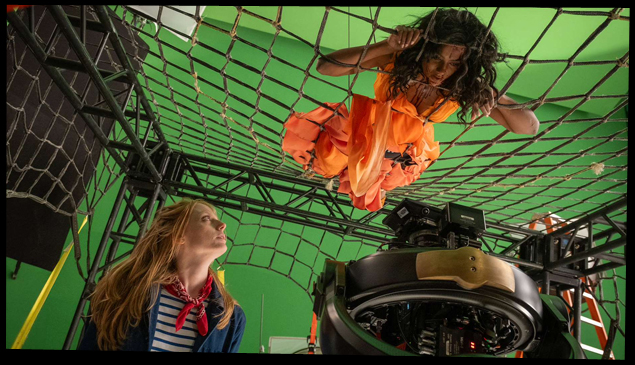
You tend to find that on independent productions because everybody is there to do the job they’re there to do. You’re also working with real locations, which presumably helps the actors inhabit that world.
In this case, we actually had to piece together a lot of locations. There were times when the locations being real helped them, and there were other times when the locations looked more real than they actually were because a portion was real and then we had to finish filming it somewhere else.
They really had to piece everything together, and it’s a non-linear project to begin with, so there was a lot for them to track.
Before we started filming each take, the big conversation with each of them was, “This is where we’re at. This is what you’ve just come out of from a story standpoint,” so everybody could track the pieces.
Finally, where can people keep up with what you’re doing and find out about your future projects?
I actually don’t have social media, intentionally. I know that’s controversial!
But I do have a website, Smokejumper Films, and my work will be up there. You’ll be able to see where we’re headed and what we’re up to.
And is there anything you can tell us about what you’re working on next?
No, it’s hushed up! It’s in process. I have several different projects in the works, so we’ll see what hits next. But I’m excited about quite a few.
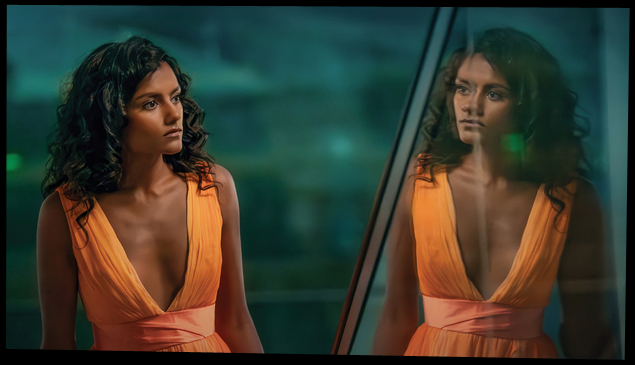
This Tempting Madness Film Page | This Tempting Madness Review
This Tempting Madness is on UK digital 10 August from Plaion Pictures
No Comment