

"as with all of Ford’s films, there is always something uniquely special about the way he makes them"
The Fan Carpet has previously interviewed members of the cast and creative team behind Bone Keeper.
Bone Keeper is the latest film from filmmaker Howard J. Ford, and as with all of Ford’s films, there is always something uniquely special about the way he makes them. Being on one of his sets must be chaos in the best possible sense.
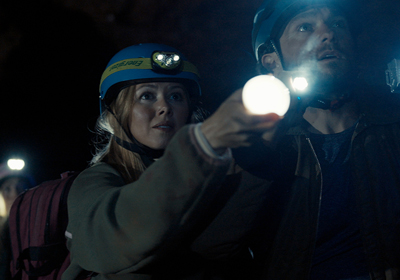
Bone Keeper may be categorised as a horror film, but to leave it at that would diminish what it actually is: an evenly paced, claustrophobic survival thriller set largely within a real cave system. In an age where creating these kinds of environments has become all too easy through advances in technology, including AI and virtual production, Ford once again follows in the spirit of films like The Ledge and River of Blood by putting real actors in real locations and letting that authenticity strengthen the story.
At its heart, Bone Keeper follows Olivia Wheeler, played by Sarah Alexandra Marks, as she searches for her mother, with Angela Dixon making a cameo, after she in turn went looking for Olivia’s grandfather, with Ford himself also appearing in a cameo. The film centres around the mysterious myth of a cave where, if you go in, you never come out. It is an effective hook, because it immediately raises the question of why anyone would go in at all when the odds are so clearly against them. That is part of the genius of Ford’s storytelling, and Bone Keeper thrives on that tension.
The film is anchored by a powerful ensemble cast, led by Marks, with Tiffany Hannam-Daniels, Louis James, Sophia Eleni, Tyler Winchcombe, Danny Rahim and Sarah T. Cohen all contributing to a strong ensemble, further underpinned by genre legend John Rhys-Davies.
Since the premise of Bone Keeper is established early, even the opening suggests that this is, a creature feature, with something crash-landing via meteorite. That is not really a spoiler, because the legend is already embedded in the world Ford and his creative team have built, but there is much more to discover and I will not give everything away here.
Underpinned by an understated score that serves the film well, Bone Keeper is also a strong example of using modern technology in the right way. Its use of AI to augment certain aspects of the production feels clever rather than intrusive, and that balance reflects Ford’s wider approach as a filmmaker. This is still a film built around real people, real locations and real tension, and that authenticity gives the piece its power. On this evidence, I have no doubt that Zip Wire, Ford’s next film, will be just as tense.
As with all great horror films, Bone Keeper leaves you wanting more. It also hints at an interesting direction and, if that is where the story goes next, I would be all for a sequel. My one caution would be not to over-explain the threat. Too often, filmmakers strip the mystery from their antagonists, but what makes Bone Keeper work is that it feels like a force of nature — and that is far more unsettling left unexplained.
Unbelievable being in this film love playing my part as Ruskin it was an incredible working with Howard Ford and the rest of the crew absolutely phenomenal and even to work on a film with John Rhys Davis is incredible really wish they got a chance to do a part of him or see him but things to come late running time I will get to see that guy and I will shake his hand away he did and this film