


"devastating, unsparing, and deeply human"
Every so often, a film refuses to soften reality. It doesn’t reassure, doesn’t console, and doesn’t look away. Josephine is one of those films: devastating, unsparing, and deeply human. Premiering at the 2026 Sundance Film Festival, where it won both the Grand Jury Prize and the Audience Award, “Josephine” announced itself not as a discovery, but as a reckoning.
Directed with quiet ferocity by Beth de Araújo, “Josephine” follows an eight-year-old girl whose innocence is shattered in an instant. One morning in San Francisco’s Golden Gate Park, while out running with her father, Josephine witnesses a brutal sexual assault. She doesn’t fully understand what she’s seen, but her body does. And once that knowledge enters her world, nothing is the same. This is a film about the aftermath—how violence doesn’t end with the act itself but ripples outward, contaminating spaces that once felt safe. Josephine begins to experience fear and paranoia, imagining the attacker in her home, in her bedroom, in the faces of men she passes on the street, and eventually even in her own father. Trauma takes root before language arrives to explain it.
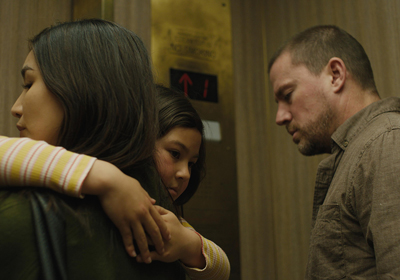
The brilliance of the film lies in its perspective; Beth de Araújo keeps the camera at Josephine’s level, forcing us to experience the world as she does: confusing, looming, suddenly hostile. Adults speak around her, over her, past her, unable to agree on how to explain what she saw. Her parents’ fracture under the weight of helplessness. Damien, played with aching frustration by Channing Tatum, believes in toughness, in preparation, in teaching his daughter how to fight back. Claire, portrayed with raw restraint by Gemma Chan, carries her own unspoken trauma and pushes for therapy, for care, for gentleness. Neither approach offers easy relief. Both are born from love. Both are incomplete. At the centre of it all is Mason Reeves, who delivers an astonishing performance as Josephine. She maintains a fragile innocence even as fear hardens inside her. Her confusion turns outward, into anger, into violence toward classmates, into resentment toward authority, and Reeves captures this psychological fracture with heartbreaking precision. Her injury cuts deep, not because it’s loud, but because it’s quiet and constant.
What makes “Josephine” so affecting is its refusal to sensationalise. This is a dark film with heavy subject matter, but it never exploits its pain. Instead, it shows how a violent act against one person can destroy many lives at once. Innocence is stolen. Families are permanently changed. And before a child even has the words to explain what they’ve seen, they’re forced to learn that fairness and justice rarely arrive together. That sometimes, people won’t even believe your truth. Not enough films confront how crime impacts children like this, how fear is learned early, how vigilance is not irrational but taught. Nearly all of that fear is learned through experiences with men, not because every man is dangerous, but because one can be enough to alter a life forever. These responses develop before language, before logic, before explanation. Once fear settles into a child’s body, it doesn’t disappear. It stays, shaping how she moves through the world. Is it even possible for a parent not to feel the weight of the world pressing down on them at all times? The outside world is cruel and confusing, and the idea of “fairness” dissolves the moment reality intrudes. Parents are left fighting an impossible battle: shielding their children for as long as they can, while knowing they must also prepare them for what’s coming. Comfort versus confrontation. Protection versus preparation. And when the real world catches up to your child before you’re ready, everything changes. There is nothing more frightening than the moment a child realises their parents are just people. That they don’t have all the answers.
“Josephine” dissects this terror with remarkable clarity. It is unapologetic in its imagery and themes, yet never loses its humanity. Amid the darkness, there is warmth. There is hope. There is even beauty. The film finds grace not by denying pain, but by moving through it. There is a sense that something strong is being forged, not a loss of innocence, but a transformation of it. This is a devastating study of a girl learning to live with trauma at a too young age. Through Josephine’s eyes, it was necessary to show the evil to understand how it affects the innocence.
Experiencing this story through a female-led perspective felt like recognition. Not relief. Not comfort. Just understanding. For the first time, the fear felt named. And that is what it means to feel truly seen. This is difficult, challenging cinema exactly as it should be.
No Comment