


"doesn’t offer easy answers or neat resolutions. It observes how fear reshapes behaviour"
Written and directed by Beth de Araújo, Josephine was inspired by real events from the director’s own life. As de Araújo explained during the press conference, the film explores “the intersection of unreasonable hypervigilance and reasonable fear that we carry while walking through the world after such events”.
Josephine is eight years old when she witnesses a sexual assault. What follows is a film about everything that comes after. Fear doesn’t explode, it settles. It slips into how Josephine looks at people, how she reads situations, how the world slowly starts to feel unsafe and contaminated.
Josephine is sharp, angry, perceptive, and often more lucid than the adults around her. She carries the film. We follow her as she tries to process what happened mostly on her own, searching inside herself for a way to deal with it.
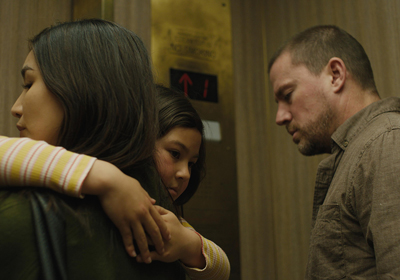
Channing Tatum is excellent as her father, Damien. His performance is controlled and deeply felt. He plays a man who truly wants to protect his daughter, but doesn’t really know how. It’s one of his strongest performances in recent years. Josephine’s mother, played by Gemma Chan, is more distant, struggling with her own unresolved pain, and this distance quietly shapes Josephine’s isolation.
When Josephine is confronted by adult authority, instead of shrinking or complying, she answers back, turning the question around. It’s brief, sharp, and powerful. No speech, no emphasis. Just a child refusing to accept the rules of a conversation that isn’t made for her. That moment feels like a release, not only for Josephine, but for anyone who has ever stayed silent in a room like that.
Josephine doesn’t offer easy answers or neat resolutions. It observes how fear reshapes behaviour, how it can be excessive and completely justified at the same time. And it shows how, even once, finding your voice can shift something. Not fix everything, but change the balance.
No Comment