


"A Familiar Tune Played Too Fast"
Teen horror has long relied on the disruption of ordinary adolescent spaces by supernatural forces, and Whistle, directed by Corin Hardy, leans heavily into that tradition. The film opens at full velocity with a cursed basketball game, signalling immediately that this is a narrative more interested in propulsion than patience. From there, Hardy situates the story within an archetypal American high school landscape — lockers, cliques, and familiar social hierarchies — rendered with such generic familiarity that many of these early sequences feel as though they could be lifted wholesale from almost any millennial-era teen movie. Yet the setting remains curiously under-explored; we move through it without gaining a meaningful sense of its culture, history, or how the supernatural threat permeates student life. Whether read as homage or creative stagnation, the familiarity is inescapable.
The central conceit — a cursed whistle that summons an inescapable death entity — recalls the mechanical fatalism of Final Destination and more recent countdown-clock horror structures, though framed here through a slightly more folkloric lens. Mythology is introduced rapidly, but without the grounding required to make its rules feel coherent or its stakes emotionally legible. Characters move from discovery to mortal peril at speed, leaving little time for audience investment.
This absence of foundation becomes the film’s defining weakness. Relationships, particularly the central romance, accelerate with implausible intensity, demanding emotional buy-in before it has been earned. Decisions that should feel tragic instead feel perfunctory, the by-product of narrative haste rather than psychological inevitability. More broadly, the teenage ensemble is sketched in broad genre strokes, making it difficult to care who survives the curse’s escalation.
Nick Frost provides the film’s most recognisable presence as a teacher drawn into the whistle’s orbit. Retaining his English accent — a welcome tonal variation amid the otherwise American cast — Frost lends early scenes a degree of intrigue and texture. Yet his role is frustratingly short-lived, introduced with narrative promise before the film’s pacing machinery moves on, sidelining both the character and the tonal weight he might have sustained.
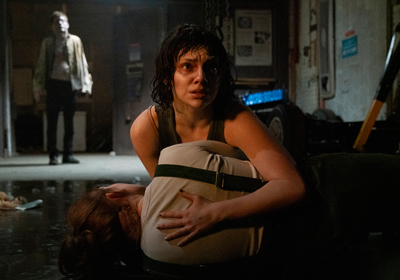
From a directorial standpoint, Whistle is competent but rarely distinctive. Hardy demonstrates a functional grasp of horror staging — the mechanics of jump scares, shadow reveals, and pursuit sequences are executed clearly — but the visual language seldom elevates the material. While there are occasional striking compositions, they feel isolated rather than cumulative, unable to compensate for the screenplay’s lack of structural depth. The film moves briskly from set-piece to set-piece, but in doing so sacrifices dread — the slow accumulation of tension that gives supernatural horror its staying power.
As momentum overrides coherence, narrative logic begins to fray. The death entity’s visibility fluctuates without clear rules; some characters perceive it while others do not, irrespective of witness presence. The curse’s origin story is gestured toward but underdeveloped, even in the opening tragedy that implies a deeper mythological awareness. Character reactions to the cursed object vary in ways that feel dramatically convenient rather than internally consistent.
World-building gaps extend beyond the supernatural. A subplot involving a high school student working hospital shifts arrives with minimal explanation, functioning transparently as a plot device rather than an organic character detail. Similarly, family figures positioned to provide emotional ballast — including a dying grandmother — are introduced without sufficient depth to generate genuine pathos.
Robin Coudert’s score works to reinforce tension, layering electronic textures and percussive shocks beneath the film’s horror beats. It is serviceable in supporting jump scares and chase sequences, though it rarely leaves a tonal imprint of its own.
Ultimately, Whistle settles into the increasingly familiar space of streaming-era teen horror: visually polished, structurally efficient, but creatively derivative. Its cursed-object hook never evolves beyond established genre mechanics, and its emphasis on speed over substance undermines the impact of its more atmospheric ambitions. It is the kind of film that functions adequately as passive viewing — background horror for a platform scroll — but struggles to command sustained attention.
There are moments that hint at a more fully realised film — glimpses of mythology, flashes of visual intent — yet they remain underdeveloped. Without the narrative grounding to support its imagery, Whistle echoes louder than it resonates: a supernatural thriller assembled from familiar parts, moving quickly but leaving little lasting impression once the sound fades. In an exhibition landscape increasingly shaped by platform turnover, Whistle feels engineered less for the big screen than for catalogue longevity — a film designed to be discovered halfway through, finished casually, and forgotten just as quickly.
No Comment