


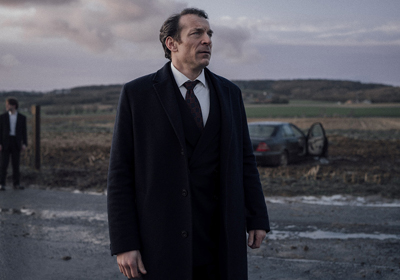
"about what people choose to protect, who they choose to betray, and what they can no longer run from"
Directed by Anke Blondé and written by Angelo Tijssens, Dust is set over the course of a single day in the spring of 1999. Belgian businessmen Luc and Geert learn that their network of shell companies is about to be exposed. By the next morning, the police will arrive. What follows is not a thriller about escape, but a film about the final hours before accountability becomes unavoidable.
The film stays very close to its characters. Mostly close-ups. Faces, gestures, silences. We are kept inside their heads, moving with their thoughts as they circle around what happened, what they did, and how they ended up here. The editing reinforces this feeling. Time folds back on itself. Memories interrupt the present. We experience the day the way they do: fragmented, obsessive, paranoid.
There are moments when you’re sure something drastic is coming, and then it doesn’t happen. The drama is internal.
The music, by Andrea Balency-Béarn, is remarkable. The cello is the main instrument of the score, yet for most of the film it remains almost unrecognisable, absorbed into the sound design, only clearly revealing itself when the characters become vulnerable.
There is a strong contrast between the controlled interiors and the few moments when the film opens up. One of them is the scene in the fields with the cows. After so many close-ups, that space feels suddenly exposed, almost uncomfortable. Nature is there, indifferent. Poetic.
The performances are key to making this work. Arieh Worthalter plays Luc with contained anxiety, always thinking, always calculating. Jan Hammenecker’s Geert is more outward, more impulsive, but no less trapped. Their friendship is central to the film. Not idealised. Not heroic. Just two men bound by shared choices and shared guilt.
DUST is a film about decisions made in the last possible moment. About what people choose to protect, who they choose to betray, and what they can no longer run from. It’s also about responsibility not as a moral lesson, but as something that slowly takes shape, whether you want it or not.
No Comment